
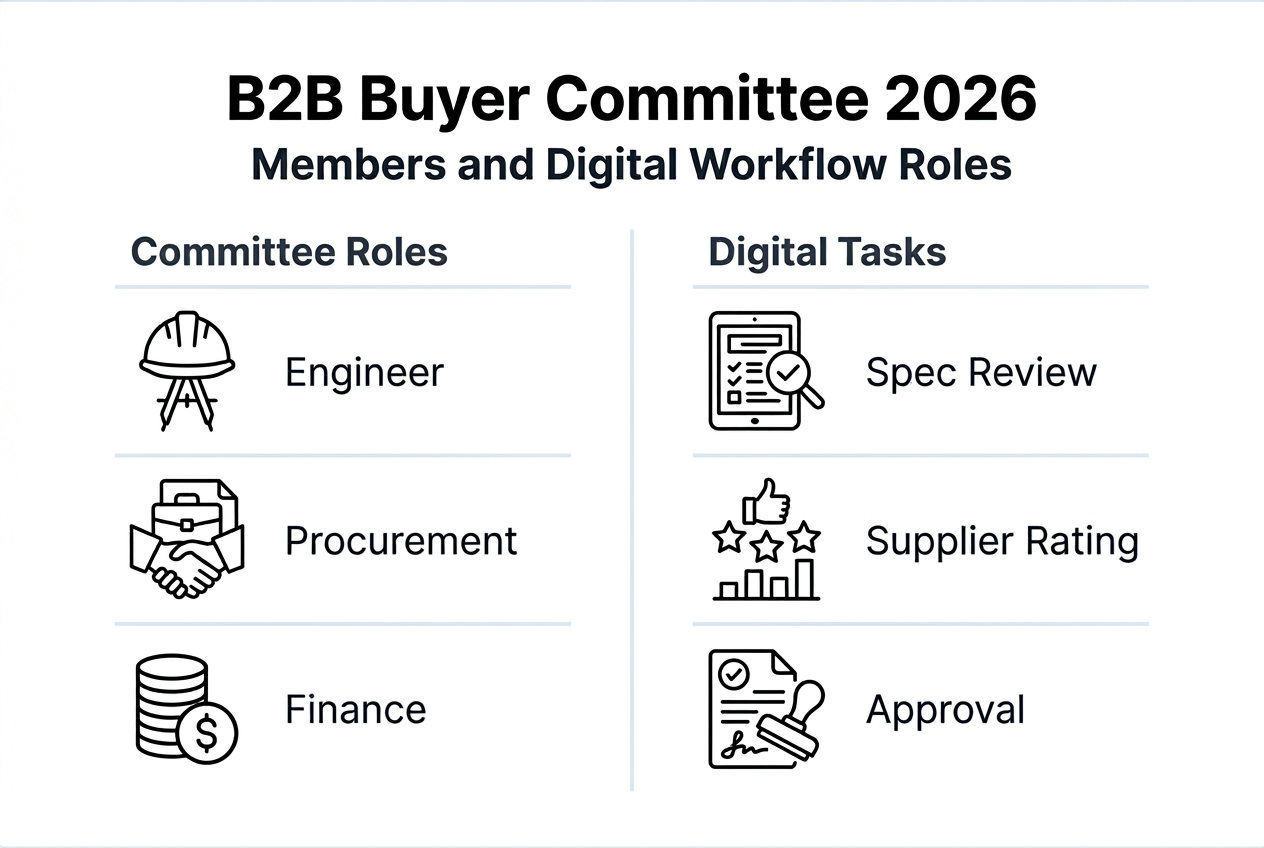
Many assume a B2B buyer is one person making purchasing decisions. That is rarely the case in industrial procurement. In manufacturing and raw materials sourcing, buying involves committees of engineers, procurement managers, plant operators, and executives. Each stakeholder contributes technical, operational, or financial perspectives. Understanding this multi-person dynamic is crucial for effective sourcing strategies and cost control in 2026.
Table of Contents
- Who Is A B2B Buyer And Why Are They Crucial In Industrial Procurement?
- How B2B Buyers Shape Procurement Strategies To Control Costs And Boost Innovation
- Digital Platforms And Evolving B2B Buyer Dynamics In Manufacturing Sourcing
- Real-World Example: How Industrial Buyers Find Tailored Solutions For Specialized Needs
- Explore Cost-Effective Industrial Materials Sourcing With Borvanta Materials
Key takeaways
| Point | Details |
|---|---|
| B2B buyers are committees | Industrial purchasing decisions involve engineers, procurement managers, plant operators, and executives working together. |
| Decision cycles are lengthy | Manufacturing B2B buying typically takes 4 to 12 months from initial evaluation to final approval. |
| Digital platforms transform sourcing | DB2B platforms integrate technical and economic domains, streamlining stakeholder communication and decision-making. |
| Procurement strategies drive value | Effective strategies balance cost control, risk mitigation, and supplier innovation to optimize industrial sourcing. |
Who is a B2B buyer and why are they crucial in industrial procurement?
A B2B buyer in industrial contexts is not a single individual. It is a committee comprising multiple stakeholders with distinct responsibilities. Engineers evaluating technical specifications, procurement managers comparing costs, plant operators assessing operational fit, and executives approving budgets all contribute to purchasing decisions. This multi-person structure ensures that materials meet technical requirements, operational needs, and budget constraints simultaneously.
The complexity of industrial materials sourcing demands this collaborative approach. Engineers focus on whether refractory minerals or industrial sands meet durability and performance standards. Procurement managers analyze supplier pricing, contract terms, and delivery schedules. Plant operators evaluate how new materials integrate into existing workflows. Executives ensure budget alignment and strategic fit.
This committee structure extends decision timelines. Manufacturing B2B purchasing decisions typically span 4 to 12 months. Each phase involves evaluation, negotiation, and approval cycles across departments. Understanding these roles helps suppliers tailor communication and proposals to address specific stakeholder concerns. Misalignment with any single buyer role can derail the entire procurement process.
Effective industrial materials supply requires recognizing these diverse perspectives. Suppliers who understand buyer committees can present solutions that satisfy technical, operational, and financial criteria simultaneously. This approach accelerates approvals and strengthens long-term partnerships.
Pro Tip: When engaging industrial buyer committees, prepare distinct materials for each stakeholder group. Engineers need technical datasheets, procurement managers want pricing comparisons, and executives require ROI summaries. Tailored communication reduces friction and speeds decision cycles.
How B2B buyers shape procurement strategies to control costs and boost innovation
B2B buyer committees directly influence procurement strategies that manage costs and stimulate supplier innovation. Effective procurement strategies in manufacturing lead to better cost management, risk reduction, and stimulation of supplier innovation. These outcomes require balancing competing priorities across technical specifications, budget constraints, and operational timelines.
Fluctuating costs for products, materials, and transportation create constant challenges. Raw material prices for refractory minerals or steel-related inputs shift based on global supply, currency fluctuations, and demand cycles. Procurement managers must implement policies that secure competitive pricing without compromising quality. This involves negotiating volume discounts, exploring alternative suppliers, and timing purchases strategically.
Risk mitigation is equally critical. Relying on single suppliers creates vulnerability to disruptions. Diversifying the supplier base and establishing backup sourcing options protect against production delays. Clear communication among buyer committee members reduces misunderstandings that lead to costly rework or specification mismatches.
Supplier innovation emerges when buyer committees foster collaborative relationships. Engaging suppliers early in product development enables them to propose alternative materials or processes that reduce costs or improve performance. This partnership approach transforms procurement from transactional purchasing to strategic value creation.
Correct procurement policies are the foundation of effective cost control and supplier collaboration in industrial sourcing. Without alignment across technical, operational, and financial stakeholders, procurement strategies fail to deliver sustained value.
Key procurement strategy elements include:
- Establishing clear technical specifications that balance performance and cost
- Implementing systematic supplier evaluation and performance tracking
- Creating communication protocols that align buyer committee members
- Developing contingency plans for supply chain disruptions
These strategies enable industrial materials supply operations to maintain consistent quality while controlling expenses. Buyer committees that execute these approaches gain competitive advantages through lower input costs and more reliable material flows.
Digital platforms and evolving B2B buyer dynamics in manufacturing sourcing
Digital transformation reshapes how B2B buyer committees operate in manufacturing sourcing. Research consolidating 82 articles from 1999 to 2024 defines digital business-to-business platforms for manufacturing by adopting an interdisciplinary approach. These platforms integrate technical and economic domains, enabling more efficient stakeholder coordination and decision-making.

Traditional B2B buying involved sequential communication. Engineers would evaluate specifications, then pass findings to procurement managers, who would negotiate with suppliers before seeking executive approval. This linear process created delays and information gaps. Digital platforms enable simultaneous access to technical datasheets, pricing models, and supplier performance metrics.
DB2B platforms also facilitate real-time collaboration among geographically dispersed buyer committee members. A procurement manager in Riga can review the same supplier proposal as an engineer in Tallinn and an executive in Vilnius. Comments, approvals, and modifications happen in shared digital workspaces rather than through email chains.
The transformation extends beyond internal coordination. Digital platforms connect buyer committees directly with supplier catalogs, inventory systems, and logistics networks. This transparency enables faster evaluation of alternative materials and suppliers. For example, if a preferred refractory mineral supplier faces delays, buyers can quickly identify and vet alternatives through the platform.
| Aspect | Traditional B2B Buying | Digital Platform B2B Buying |
|---|---|---|
| Communication | Sequential, email-based | Simultaneous, platform-based |
| Data Access | Fragmented across departments | Centralized, real-time |
| Supplier Evaluation | Manual, time-intensive | Automated, metric-driven |
| Decision Speed | 6 to 12 months typical | 3 to 8 months typical |
| Stakeholder Alignment | Periodic meetings | Continuous collaboration |
Despite these advantages, digital adoption requires careful implementation. Buyer committees must align on data standards, access protocols, and decision workflows. Technical teams need training on platform features, while procurement managers require integration with existing ERP systems.
Pro Tip: Most procurement managers miss cross-functional coordination needs when moving to digital platforms. Establish clear roles for data input, approval workflows, and exception handling before platform launch. Without this groundwork, digital tools create confusion rather than efficiency.
Exploring industrial product catalogs through digital platforms enables faster material specification and supplier comparison, accelerating the entire procurement cycle.
Real-world example: How industrial buyers find tailored solutions for specialized needs
A practical case illustrates how buyer committees navigate complex sourcing decisions. A major European packaging provider found a customized solution for harsh outdoor applications through systematic evaluation and supplier collaboration. This example demonstrates the multi-stakeholder coordination required for specialized industrial materials.
The packaging provider needed materials that withstood extreme temperatures, UV exposure, and physical stress. Off-the-shelf solutions failed performance requirements. The buyer committee included materials engineers who defined technical specifications, procurement managers who evaluated cost implications, operations staff who assessed production integration, and executives who approved investment.
The sourcing process followed these steps:
-
Technical specification development: Materials engineers defined performance criteria including temperature range, UV resistance, tensile strength, and dimensional stability. These specifications became the baseline for supplier evaluation.
-
Supplier identification and outreach: Procurement managers researched potential suppliers with expertise in specialized polymer compounds. They requested technical datasheets and samples from five candidates.
-
Sample testing and evaluation: Operations staff conducted real-world testing of samples under simulated harsh conditions. Two suppliers met initial performance criteria.
-
Cost analysis and negotiation: Procurement managers compared total cost of ownership including material pricing, minimum order quantities, delivery terms, and tooling requirements. One supplier offered 35% lower costs through optimized formulation.
-
Pilot production and validation: The buyer committee approved a pilot run with the selected supplier. Production teams validated that the material integrated smoothly into existing manufacturing processes.
-
Contract finalization and rollout: Executives approved the final contract after confirming technical performance, cost savings, and supply reliability. Full production rollout followed successful pilot results.
This systematic approach highlights several critical success factors. Clear communication among buyer committee members prevented specification drift and budget surprises. Early supplier engagement enabled customization that balanced performance and cost. Pilot testing validated assumptions before full commitment.
The case also demonstrates benefits of effective B2B buyer coordination. The packaging provider achieved significant cost savings while meeting demanding technical requirements. The supplier gained a long-term customer through collaborative problem-solving. Both parties benefited from the structured, multi-stakeholder evaluation process.
Industrial buyers facing similar challenges can apply this framework. Define specifications collaboratively, engage suppliers early, test thoroughly, and align stakeholders throughout the process. This approach reduces risk and improves outcomes for complex industrial sourcing solutions.
Explore cost-effective industrial materials sourcing with Borvanta Materials
Navigating complex B2B buyer dynamics requires reliable supply partners who understand multi-stakeholder procurement. Borvanta Materials specializes in industrial materials supply for manufacturers and distributors across the Baltics and Europe. We source refractory minerals, industrial sands, steel-related materials, polymers, and other essential inputs at 30 to 40% below average market prices.
Our approach addresses the diverse needs of buyer committees. Engineers receive detailed technical specifications and performance data. Procurement managers access transparent pricing and flexible terms. Operations teams benefit from reliable delivery and quality consistency. We serve smaller businesses and entrepreneurs who need competitive pricing without compromising on material quality or supply reliability.
Explore specialized materials like kyanite-sillimanite refractory for high-temperature applications or molding sand silica for precision casting. Our catalog supports diverse industrial requirements with straightforward commercial terms designed for efficiency.
FAQ
What is the role of engineers in B2B industrial buying?
Engineers evaluate technical specifications to ensure materials meet operational requirements. They define performance criteria for durability, chemical resistance, temperature tolerance, and dimensional accuracy. Their input establishes the baseline for supplier evaluation and material selection.
How can procurement managers manage fluctuating costs effectively?
Implement procurement policies that balance cost and quality through volume negotiations and strategic timing. Cost control addresses fluctuating costs of products, materials, and transportation by diversifying suppliers and maintaining clear communication. These practices reduce costly misunderstandings and secure competitive pricing.
What advantages do digital B2B platforms offer industrial buyers?
Digital business-to-business platforms integrate technical and economic domains, making manufacturing sourcing more efficient. They streamline communication among stakeholders and enable faster, informed decision-making. Real-time data access and collaborative workspaces reduce delays typical in traditional sequential buying processes.
Why is committee-based decision-making common in B2B industrial purchases?
Complexity requires expertise from multiple departments to evaluate technical, operational, and financial factors. Manufacturing B2B purchasing decisions typically involve committees and take 4 to 12 months to ensure thorough evaluation and budget approval. This structure reduces risk and aligns diverse stakeholder needs.