
European manufacturers face mounting pressure from raw material shortages, unpredictable pricing, and supply chain disruptions that threaten production schedules and profit margins. With 37% of EU manufacturing firms facing critical access issues to commodities and raw materials, strategic procurement is no longer optional. This guide provides actionable strategies for European buyers to secure reliable supply, reduce costs, and build resilient sourcing frameworks in 2026.
Table of Contents
- Understanding The Raw Material Procurement Landscape In Europe
- Preparing For Procurement: Assessing Needs And Supplier Options
- Executing Procurement: Sourcing, Negotiation, And Supplier Engagement
- Verifying And Optimizing Procurement Outcomes
- Why Choose Borvanta Materials For Your Raw Material Supply
- What Is The Critical Raw Materials Act And How Does It Impact Procurement?
- How Can Small And Mid-Sized Enterprises Mitigate Supply Chain Risks?
- What Are The Benefits Of Using Technology Platforms In Raw Material Procurement?
Key takeaways
| Point | Details |
|---|---|
| Supply chain vulnerability | Over half of European enterprises report raw material shortages affecting operations. |
| Strategic sourcing approach | Balance cost optimization with risk mitigation and lead time reliability. |
| Technology platforms | Digital tools accelerate supplier discovery and can reduce procurement costs by 30-50%. |
| Regulatory landscape | The CRMA reshapes European procurement priorities for critical materials. |
| Continuous improvement | Monitor KPIs and supplier performance to optimize procurement outcomes over time. |
Understanding the raw material procurement landscape in Europe
European manufacturers operate in an increasingly complex procurement environment shaped by geopolitical tensions, logistics bottlenecks, and regulatory shifts. The landscape demands strategic thinking beyond simple cost comparisons.
The Critical Raw Materials Act represents a fundamental shift in European policy. The CRMA shifts European raw material policy toward strategic intervention due to supply vulnerabilities, prioritizing security of supply alongside cost efficiency. This regulatory framework affects sourcing decisions across multiple industries, from electronics to renewable energy.
Current market conditions reveal significant pressure points. 52% of European enterprises reported raw material supply shortages, with manufacturing heavy economies experiencing the most severe impacts. These disruptions cascade through production schedules, forcing manufacturers to maintain higher inventory levels and explore alternative sourcing strategies.
Key challenges facing European buyers include:
- Concentrated supplier bases creating single points of failure
- Extended lead times from traditional Asian suppliers
- Price volatility driven by energy costs and logistics constraints
- Quality inconsistencies requiring enhanced verification processes
- Regulatory compliance complexity across different jurisdictions
The market has shifted decisively toward strategic sourcing models that prioritize supply security and total cost of ownership over simply pursuing the lowest unit price. Companies that fail to adapt risk production stoppages and lost market share.
"Public acceptance of the CRMA framework is vital for its success in strengthening European raw material supply chains while maintaining environmental commitments."
This evolving industrial supply landscape requires procurement professionals to develop sophisticated risk assessment capabilities and maintain flexible sourcing strategies that can respond quickly to market disruptions.
Preparing for procurement: assessing needs and supplier options
Effective procurement begins with clear internal assessment before engaging suppliers. You need precise specifications and volume forecasts to evaluate options meaningfully.
Start by defining your raw material requirements:
- Specify technical requirements including grade, purity, and physical properties
- Calculate volume needs for 6-12 months based on production forecasts
- Identify acceptable substitutes or alternative materials
- Determine delivery schedule requirements and storage capacity
- Document quality control standards and testing protocols
Once you understand your needs, evaluate supplier options systematically. The local versus international sourcing decision involves multiple tradeoffs. Local sourcing can reduce lead times by up to 30% but may not always offer competitive pricing, particularly for commodity materials.

International sourcing typically provides cost advantages and access to specialized materials unavailable locally. However, longer lead times, currency risk, and complex logistics require careful management. Many successful manufacturers use hybrid approaches, securing critical materials locally while sourcing commodity inputs internationally.
Consider these factors when evaluating suppliers:
- Total landed cost including freight, duties, and handling
- Lead time reliability and production scheduling flexibility
- Quality consistency and defect rates
- Financial stability and business continuity planning
- Technical support and problem solving capabilities
- Environmental and social compliance standards
Recent data shows 70% of business leaders have re-internalized functions previously outsourced abroad to manage risk better, reflecting the strategic shift toward supply chain resilience.
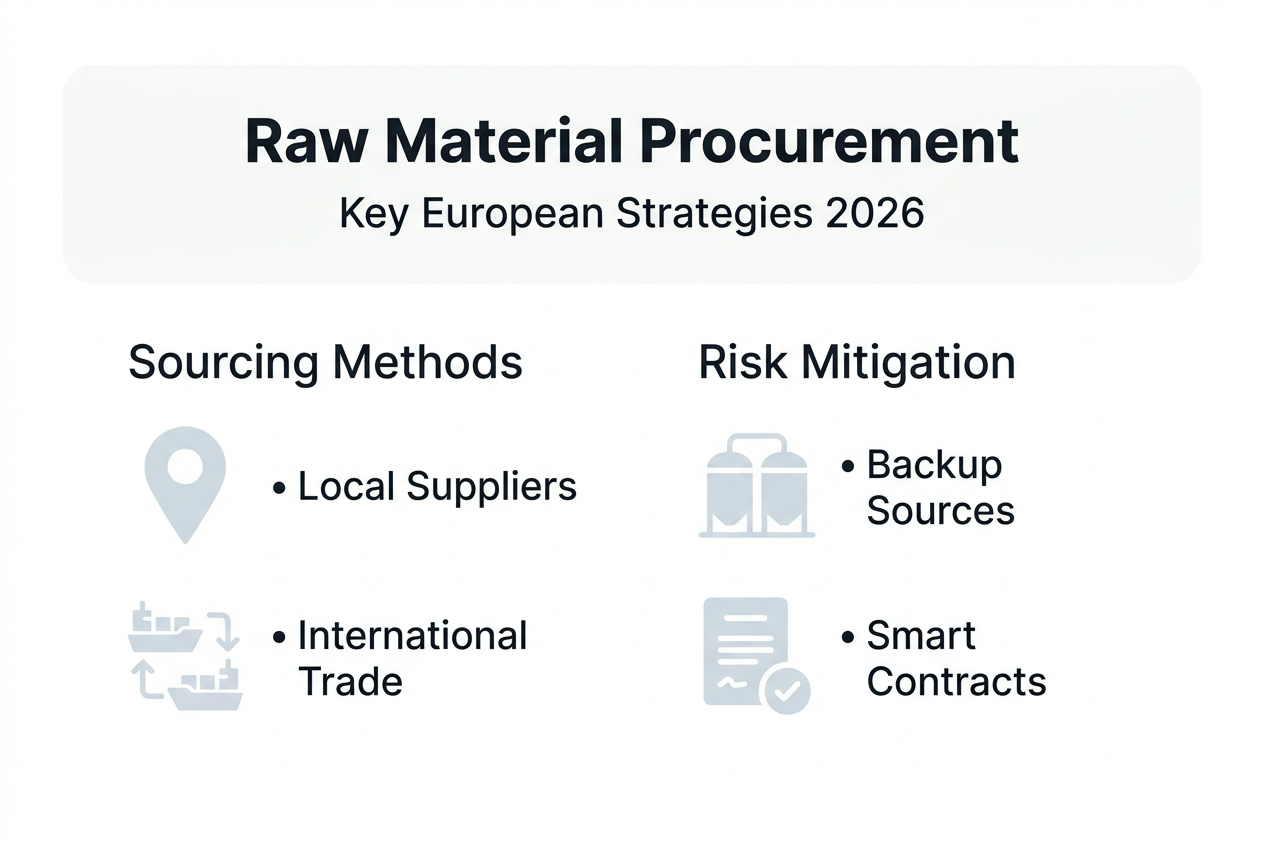
Pro Tip: Balance cost savings with supply chain security by maintaining relationships with both primary and backup suppliers. The cost of qualifying a secondary source is minimal compared to production downtime from supply disruptions.
Document your supplier evaluation criteria and weight factors according to your strategic priorities. This structured approach enables objective comparisons and supports internal decision making. Many procurement professionals find risk management in procurement frameworks helpful for systematizing these assessments.
Executing procurement: sourcing, negotiation, and supplier engagement
Moving from planning to execution requires systematic supplier identification, contract negotiation, and relationship building that extends beyond transactional exchanges.
Digital platforms have transformed supplier discovery. Matchory platform helped Reifenhäuser reduce costs by up to 50% by identifying key suppliers beyond Central Europe, demonstrating the power of technology enabled sourcing. These platforms aggregate supplier capabilities, pricing data, and performance metrics that would take months to compile manually.
Baltic Sourcing stresses reliability and transparency in connecting European manufacturers with global suppliers, highlighting how specialized intermediaries add value through market knowledge and supplier vetting.
Follow this negotiation sequence for optimal outcomes:
- Request detailed quotes including all cost components and payment terms
- Compare total landed costs across multiple suppliers
- Negotiate volume discounts and contract duration benefits
- Clarify quality specifications and inspection protocols
- Define delivery schedules with penalty clauses for delays
- Establish communication protocols and escalation procedures
- Secure contract flexibility for volume adjustments
Contract negotiations should address more than price. Payment terms, quality guarantees, liability provisions, and force majeure clauses protect both parties and prevent disputes. Build in mechanisms for price adjustments tied to market indices rather than accepting fixed prices over extended periods.
| Sourcing Approach | Cost Advantage | Supply Risk | Lead Time | Sustainability |
|---|---|---|---|---|
| Local European | Moderate | Low | Short (1-2 weeks) | High |
| Regional (EU + neighbors) | Good | Low-Moderate | Medium (2-4 weeks) | Medium-High |
| Global (Asia, Americas) | Excellent | Moderate-High | Long (6-12 weeks) | Variable |
| Hybrid (mixed sources) | Good | Low | Flexible | Optimized |
Supplier engagement extends beyond contract execution. Share production forecasts to help suppliers plan capacity. Invite suppliers to suggest process improvements or material alternatives that could reduce costs. This collaborative approach often uncovers innovation opportunities missed in purely transactional relationships.
Pro Tip: Consolidate your supplier base strategically to increase your purchasing power while maintaining backup sources for critical materials. Transparency with suppliers about your volume commitments enables them to offer better terms and prioritize your orders during tight supply periods.
Implement supplier selection best practices that emphasize both quantitative metrics and qualitative factors like communication responsiveness and problem solving orientation.
Verifying and optimizing procurement outcomes
Procurement success requires ongoing monitoring and continuous improvement rather than set and forget contract management.
Track these key performance indicators systematically:
- On time delivery rate (target: 95% or higher)
- Quality acceptance rate and defect frequency
- Total cost variance from budgeted spend
- Lead time consistency and forecast accuracy
- Supplier responsiveness to inquiries and issues
- Contract compliance on terms and conditions
Post order risk management remains critical throughout the supply cycle. 34% of EU firms are affected by logistics and transport disruptions, especially manufacturing SMEs, making shipment tracking and proactive communication essential. Implement alerts for delayed shipments and maintain contingency plans for critical materials.
Conduct formal supplier performance reviews quarterly. Document strengths, weaknesses, and improvement areas. Share feedback constructively and establish joint action plans to address recurring issues. Top performing suppliers deserve recognition and potentially expanded business.
Continuous improvement cycles should examine:
- Opportunities to consolidate orders for better pricing
- Alternative materials that could reduce costs without compromising quality
- Process changes that could extend material usage or reduce waste
- Market trends suggesting optimal timing for contract renewals
- Technology investments that could streamline procurement workflows
Avoid these common verification pitfalls:
- Accepting delivery without thorough quality inspection
- Failing to document and track supplier performance issues
- Neglecting to compare actual costs against initial quotes
- Ignoring early warning signs of supplier financial distress
- Missing opportunities to renegotiate based on market changes
- Letting relationships with backup suppliers deteriorate
Many successful procurement teams adopt procurement optimization techniques that blend data analytics with supplier relationship management. This balanced approach identifies cost reduction opportunities while maintaining the supply reliability that keeps production running smoothly.
Why choose Borvanta Materials for your raw material supply
Implementing the procurement strategies outlined in this guide requires suppliers who understand European market dynamics and deliver reliable value.

Borvanta Materials serves as a strategic partner for Baltic and European manufacturers seeking competitively priced industrial raw materials without compromising supply reliability. We specialize in refractory minerals, industrial sands, steel related materials, polymers, and other essential manufacturing inputs.
Our pricing model targets 30-40% below average market rates, particularly benefiting smaller manufacturers and entrepreneurs who often face less favorable terms from larger suppliers. This cost advantage directly supports the strategic sourcing principles discussed throughout this guide.
We maintain industrial materials supply capabilities across multiple product categories, enabling consolidated procurement that simplifies your supplier management. Our product catalog spans diverse applications from basic materials like steel sheets 10mm to specialized industrial inputs.
Our team brings practical expertise in navigating European supply chains, customs regulations, and logistics networks. We help clients implement resilient procurement strategies that balance cost optimization with supply security, whether you need ongoing supply contracts or spot purchases for specific projects.
What is the Critical Raw Materials Act and how does it impact procurement?
The CRMA represents the European Union's strategic response to raw material supply vulnerabilities exposed by recent geopolitical tensions and supply chain disruptions. The CRMA establishes a list of 34 critical raw materials important economically and with high supply risk.
For manufacturers, the CRMA influences procurement priorities by identifying materials where diversified sourcing and strategic stockpiling may be prudent. The regulation encourages development of European processing capacity and recycling infrastructure, potentially creating new local sourcing options over time.
How can small and mid-sized enterprises mitigate supply chain risks?
SMEs should adopt multi-layered risk mitigation strategies that don't require massive capital investments. Supplier diversification and local sourcing can reduce risks and lead times for SMEs facing supply uncertainties.
Maintain relationships with at least two qualified suppliers for critical materials, even if you primarily order from one. Monitor logistics performance closely and communicate proactively with suppliers about production forecasts. Consider risk management in procurement frameworks designed for smaller organizations with limited resources.
What are the benefits of using technology platforms in raw material procurement?
Digital procurement platforms accelerate supplier discovery by aggregating market data that would take weeks to compile manually. Platforms like Matchory help identify suppliers and reduce costs significantly, sometimes cutting procurement costs by 30-50% through better market visibility.
These tools enable data driven comparisons across suppliers, transparent pricing benchmarks, and streamlined communication. For smaller procurement teams, technology platforms effectively multiply your market reach without adding headcount. Learn more about supplier selection best practices that incorporate digital tools effectively.