
Selecting the right casting material is one of the most challenging decisions procurement professionals face. You need to balance mechanical properties, cost constraints, and supplier reliability while ensuring your materials arrive on time and meet exact specifications. This guide walks you through the complete selection process, from understanding material requirements to verifying quality upon delivery. You will learn how to evaluate casting materials, analyze costs in the Baltic industrial surplus market, and avoid common procurement pitfalls that can derail your projects.
Table of Contents
- Key takeaways
- Understanding casting material requirements
- Evaluating cost and supplier options in the Baltic industrial surplus market
- Step-by-step guide to casting material selection and purchase
- Quality verification and common pitfalls in casting material procurement
- Explore below-market casting materials and refractory stock with Borvanta
- Frequently asked questions about casting material selection
Key Takeaways
| Point | Details |
|---|---|
| Match material to process | Select casting materials that align with the production process to optimize fluidity, strength, and overall quality. |
| Total cost considerations | Total cost includes raw materials and processing steps such as melting, molding, finishing, and quality control, which can add 40 to 60 percent to the final unit price. |
| Surplus refractories savings | Surplus and recycled refractories from Baltic suppliers can provide 15 to 30 percent savings while maintaining specifications. |
| Supplier certification checks | Verify supplier certifications and material test reports to ensure quality and traceability of the casting materials. |
Understanding casting material requirements
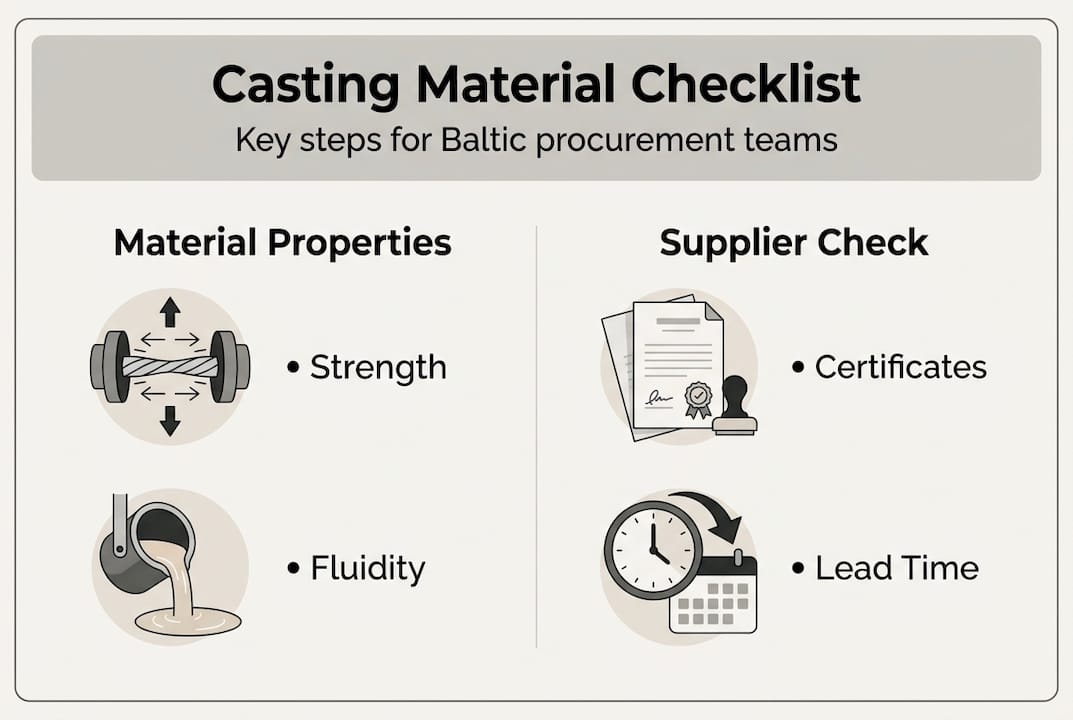
Selecting casting materials requires understanding how mechanical properties, fluidity, and corrosion resistance affect your final product. Key factors include mechanical properties, cost, corrosion resistance, fluidity, melting point, and process compatibility. Tensile strength determines how much stress your casting can withstand before failure. Hardness affects wear resistance and machining difficulty. Ductility measures how much your material can deform without cracking, critical for components subjected to bending or impact loads.
Fluidity determines how well molten material fills intricate mold cavities. High fluidity materials like aluminum produce detailed castings with thin walls and complex geometries. Melting point must align with your furnace capabilities and energy costs. Lower melting points reduce fuel consumption and equipment wear, making aluminum and zinc alloys attractive for high-volume production. Castability encompasses shrinkage rate, hot tearing tendency, and gas porosity risk, all affecting final casting quality.
Corrosion resistance becomes critical for castings exposed to moisture, chemicals, or marine environments. Gray iron offers excellent vibration damping for machine bases and engine blocks. Ductile iron provides higher ductility than gray iron while maintaining good castability. Aluminum alloys deliver high strength-to-weight ratios with superior corrosion resistance, ideal for automotive and aerospace applications. Each material brings distinct advantages depending on your application requirements.
Common casting materials and their properties:
- Aluminum alloys: excellent fluidity, low density, good corrosion resistance, suitable for die casting and sand casting
- Gray iron: superior vibration damping, easy machinability, lower cost, preferred for machine bases and housings
- Ductile iron: higher tensile strength than gray iron, better impact resistance, used for automotive components
- Steel: highest strength and hardness, poor castability, requires higher melting temperatures and specialized equipment
- Copper alloys: excellent thermal and electrical conductivity, good corrosion resistance, higher material costs
| Material | Tensile Strength (MPa) | Melting Point (°C) | Relative Cost | Best Applications |
|---|---|---|---|---|
| Aluminum A356 | 228-283 | 615 | Medium | Die casting, automotive parts |
| Gray Iron Class 30 | 207 | 1150 | Low | Machine bases, engine blocks |
| Ductile Iron 65-45-12 | 448 | 1149 | Medium | Gears, crankshafts, suspension |
| Carbon Steel | 400-550 | 1425 | High | Heavy machinery, structural |
| Bronze | 275-635 | 950 | Very High | Bearings, marine hardware |
Pro Tip: Match your casting material to your specific process. Die casting demands high fluidity materials like aluminum or zinc. Sand casting accommodates materials with lower fluidity like iron and steel. Investment casting works well with stainless steel and superalloys for precision components. Choosing the wrong material-process combination leads to defects, scrap, and budget overruns.
Working with foundry and procurement support helps you navigate these technical requirements and select materials that meet your exact specifications while staying within budget constraints.
Evaluating cost and supplier options in the Baltic industrial surplus market
Total cost analysis extends beyond raw material pricing. Processing expenses including melting, molding, finishing, and quality control add 40-60% to your final per-unit cost. Prioritize recycled/surplus refractories from REF Minerals for competitive pricing in Baltic industrial market. Surplus materials offer identical specifications at 15-30% below market rates, providing immediate budget relief without compromising quality standards.

Supplier reliability determines whether your production schedule stays on track. Verify MTRs, ISO certs; use local Baltic producers for speed, imports for high-spec needs. Material test reports confirm chemical composition, mechanical properties, and compliance with international standards. ISO 9001 certification indicates consistent quality management systems. Request both documents before committing to any supplier relationship.
Local Baltic suppliers provide faster delivery times, typically 3-7 days for standard materials. Import suppliers require 4-8 weeks but offer access to specialized alloys and high-performance materials unavailable locally. Balance lead time requirements against material specifications. Rush projects demand local sourcing even at slightly higher costs. Planned production runs allow time for imported materials at better prices.
| Sourcing Option | Lead Time | Price Range | Quality Verification | Best For |
|---|---|---|---|---|
| Local Baltic suppliers | 3-7 days | Medium-High | ISO certs, local reputation | Urgent orders, standard materials |
| Surplus/recycled stock | 1-5 days | Low-Medium | MTRs, third-party testing | Budget-conscious projects |
| European imports | 2-4 weeks | Medium | Full documentation | Specialized alloys |
| Asian imports | 6-8 weeks | Low-Medium | Variable, verify carefully | High-volume, cost-sensitive |
| Direct from mills | 4-6 weeks | High | Comprehensive | Critical applications |
Surplus refractory materials deserve special attention. These materials come from canceled orders, production overruns, or facility closures. They meet original specifications but sell at significant discounts. Verify storage conditions to ensure materials have not degraded. Check packaging integrity and expiration dates for time-sensitive products like certain bonding agents.
Cost comparison factors to evaluate:
- Base material price per kilogram or ton
- Minimum order quantities and volume discounts
- Transportation costs from supplier to your facility
- Import duties and customs clearance fees for international orders
- Payment terms and early payment discounts
- Technical support and documentation provided
- Return policies for non-conforming materials
Pro Tip: Build relationships with multiple suppliers across different categories. Maintain a primary local supplier for routine needs and urgent orders. Develop connections with surplus material brokers for cost-sensitive projects. Establish import channels for specialized materials. This diversified approach protects against supply disruptions and provides negotiating leverage.
Explore refractory materials offers and mold casting sand offers to access below-market pricing on quality materials suited for Baltic foundry operations.
Step-by-step guide to casting material selection and purchase
Systematic material selection eliminates guesswork and reduces procurement errors. Follow this proven process to match materials with your project requirements while optimizing costs and delivery schedules.
-
Define your casting process and application requirements. Identify whether you are using die casting, sand casting, investment casting, or permanent mold casting. Document required mechanical properties including minimum tensile strength, hardness range, and ductility. Specify environmental conditions the casting will face such as temperature extremes, corrosive chemicals, or wear conditions.
-
Create a shortlist of candidate materials. Research materials commonly used for similar applications in your industry. Consult casting material databases and technical references. Consider both conventional options and alternative materials that might offer cost or performance advantages. Include surplus and recycled options to maximize budget efficiency.
-
Request supplier documentation and verify credentials. Prioritize recycled/surplus refractories and verify certifications to ensure competitive pricing and quality. Contact potential suppliers and request material test reports, ISO certifications, and technical data sheets. Verify that chemical composition and mechanical properties meet your specifications. Check supplier references and industry reputation.
-
Compare comprehensive quotes from multiple sources. Request detailed quotations including material cost, minimum order quantities, and delivery terms. Calculate total landed cost including transportation, duties, and handling fees. Factor in payment terms and any early payment discounts. Evaluate lead times against your production schedule requirements.
-
Place your order with complete specification clarity. Provide suppliers with detailed purchase orders specifying exact material grades, quantities, and delivery dates. Include quality requirements and acceptance criteria. Confirm inspection procedures and documentation to be provided with shipment. Establish clear communication channels for order updates.
-
Arrange receiving inspection and quality verification. Schedule material testing upon delivery to confirm specifications. Verify packaging integrity and check for shipping damage. Review all documentation including MTRs, certificates of conformance, and shipping records. Document any discrepancies immediately and contact suppliers to resolve issues before materials enter production.
Key documentation to request:
- Material test reports showing chemical composition and mechanical properties
- ISO 9001 or equivalent quality management certifications
- Certificates of conformance confirming materials meet specified standards
- Technical data sheets with processing recommendations
- Safety data sheets for handling and storage requirements
- Traceability documentation linking materials to production batches
Pro Tip: Create a supplier scorecard tracking on-time delivery, quality conformance, documentation accuracy, and responsiveness. Review scores quarterly and adjust your supplier mix based on performance data. This objective approach identifies reliable partners and flags problematic suppliers before they disrupt production.
Browse industrial stock product offers to discover available materials matching your specifications, or visit below-market industrial stock for current opportunities in the Baltic surplus market.
Quality verification and common pitfalls in casting material procurement
Receiving inspection protects against costly production failures. Verify MTRs, ISO certs; local Baltic producers offer speed for maintenance, imports for high-spec. Compare material certificates against delivered products to confirm exact specifications. Check lot numbers, heat numbers, and production dates match documentation. Discrepancies indicate potential quality issues or shipping errors requiring immediate supplier contact.
Visual inspection reveals obvious defects before materials enter production. Examine materials for surface contamination, rust, moisture damage, or physical damage from shipping. Check packaging integrity and storage condition indicators. Reject materials showing signs of improper handling or storage. Document all observations with photographs for supplier discussions if needed.
Basic testing confirms critical properties. Hardness testing verifies heat treatment and material grade. Spectrometer analysis checks chemical composition against specifications. Dimensional verification ensures materials meet size requirements. These simple tests catch most quality issues before expensive processing begins. Invest in basic testing equipment or partner with local testing laboratories for quick turnaround.
Common procurement mistakes to avoid:
- Ignoring shrinkage rates when calculating material quantities, leading to insufficient material for mold filling
- Mismatching material properties to casting process, such as using low-fluidity materials in die casting
- Skipping certification verification to save time, risking non-conforming materials entering production
- Ordering minimum quantities without considering scrap rates and process losses
- Failing to establish clear acceptance criteria before materials arrive
- Neglecting to verify supplier storage and handling practices for moisture-sensitive materials
- Accepting verbal assurances instead of documented test reports and certifications
Blending incompatible materials creates unpredictable results. Different alloy grades, even within the same material family, can produce castings with inconsistent properties. Contamination from previous melts affects chemical composition and mechanical performance. Maintain strict material segregation and tracking systems. Never mix materials from different suppliers or lots without thorough testing and documentation.
"Quality verification is not optional in casting material procurement. Every hour spent confirming specifications prevents days of production delays and thousands in scrap costs. Document everything, test systematically, and never compromise on certification requirements."
Maintain open communication channels with suppliers for rapid issue resolution. Establish direct contacts for technical questions and quality concerns. Share feedback on material performance to help suppliers improve. Strong supplier relationships enable faster problem solving and often result in preferential treatment during supply shortages. Treat suppliers as partners in your quality system rather than adversarial vendors.
Reference the industrial materials glossary when reviewing technical specifications to ensure accurate interpretation of material properties and industry terminology.
Explore below-market casting materials and refractory stock with Borvanta
Sourcing casting materials at competitive prices requires access to specialized suppliers focused on industrial surplus opportunities. Borvanta connects Baltic procurement professionals with one-off, below-market stock ideal for cost-conscious foundry operations. The platform specializes in surplus casting sands, refractory minerals, and related materials perfectly suited for foundries throughout the Baltic region.
Access real-time inventory of below-market industrial stock with detailed technical specifications and transparent pricing. Each listing includes comprehensive documentation, material test reports, and flexible delivery terms tailored to Baltic logistics networks. Procurement support helps you evaluate materials against your specific requirements and navigate technical questions throughout the purchasing process.
Explore specialized foundry offers and procurement support designed specifically for casting operations. Whether you need molding sand, refractory materials, or specialty casting supplies, the platform provides curated opportunities matching foundry specifications. Review current industrial stock offers to discover available materials and secure competitive pricing for your next project.
Frequently asked questions about casting material selection
What are the top mechanical properties to consider for casting materials?
Tensile strength, hardness, and ductility form the foundation of casting material selection. Tensile strength determines load-bearing capacity, hardness affects wear resistance and machinability, while ductility measures deformation capability before failure. Also evaluate yield strength for components under stress and impact resistance for shock-loaded applications.
How do I verify supplier quality certifications effectively?
Request material test reports showing chemical composition and mechanical properties from accredited laboratories. Confirm ISO 9001 certification through official registrar databases rather than accepting supplier-provided certificates alone. Check that MTRs include heat numbers matching delivered materials and verify testing dates are recent and relevant to your order.
Why consider surplus or recycled refractory materials?
Surplus refractories offer 15-30% cost savings while meeting identical specifications as new materials. These materials come from canceled orders or production overruns, not used or degraded stock. They provide immediate availability, often with faster delivery than ordering new materials, making them ideal for budget-conscious projects without compromising quality standards.
What casting materials suit die casting versus sand casting?
Die casting requires high-fluidity materials like aluminum alloys, zinc, and magnesium that fill intricate mold cavities quickly. Sand casting accommodates lower-fluidity materials including iron, steel, and bronze, offering flexibility for larger castings and lower production volumes. Match material fluidity to your process complexity and production speed requirements.
How to avoid common mistakes in casting material procurement?
Always verify certifications before ordering, calculate quantities including shrinkage allowances, and match material properties to your specific casting process. Establish clear acceptance criteria documented in purchase orders. Never blend materials from different suppliers or lots without testing. Maintain detailed records of supplier performance to identify reliable partners and avoid problematic sources.